
You have an AC cleaner in your basket, or a can is already waiting in the cupboard, and you want to know one thing: is it enough? It is a fair question. Nobody wants to book a visit for a job a spray could handle, and nobody wants to spray the wrong part of the AC either.
Here is the short answer. An air conditioner cleaner, or an ac coil cleaner, works only where you apply it: on the parts you can see and reach once the front panel is open. It does not reach the drain tray, the blower or the ducts, and Trane, an AC maker, says most coil cleaning should be left to a technician.
In this guide, you will find what these products are, where they can and can't reach, how to use one safely, the signs that call for a professional clean, and what a professional clean covers. Every technical point links to its source: the US EPA, ENERGY STAR, Trane and LG.
What is an AC cleaner, and what does it actually do?
An AC cleaner is a spray or a foam made to loosen dirt on the coil of an air conditioner. It works on the surface it touches, and nowhere else.
To see why that matters, start with the coil. The coil is the block of thin metal fins and tubes that the air passes through. According to Trane, a split system has two: the evaporator coil in the indoor unit, which absorbs heat and humidity from your home, and the condenser coil in the outdoor unit, which releases that heat outside.
Trane also explains that commercial cleaners can work on both coils, and that they come in many forms, from foaming solutions to self-rinsing formulas. So the product itself can do its job. The question is where you can put it. A can sprays what is in front of it. It does not open the unit, and it does not travel to the parts hidden behind the panel or inside the ducts.
AC coil cleaner, AC evaporator cleaner, foaming or no-rinse: what the labels mean
The names on the shelf can be confusing. Here is what they usually describe:
- AC coil cleaner: a general name for a product made for the coils of an air conditioner, indoor or outdoor.
- AC evaporator cleaner: a product sold for the evaporator, the coil inside the indoor unit.
- Foaming cleaner: a product that comes out as a foam on the coil.
- Self-rinsing or no-rinse cleaner: a product you do not wash off with water. Trane describes how a technician uses one on the indoor coil: the solution rinses off on its own once the unit runs again and the cooling process continues.
Whatever the label says, read it and follow the instructions on it. Each product has its own way of use.
Good to know: in the method Trane describes, the technician turns the unit off, removes loose dirt by hand, then opens up the unit to reach the indoor coil before spraying. The opening is the part a can does not do for you.
Where can an ac coil cleaner reach, and where can't it?
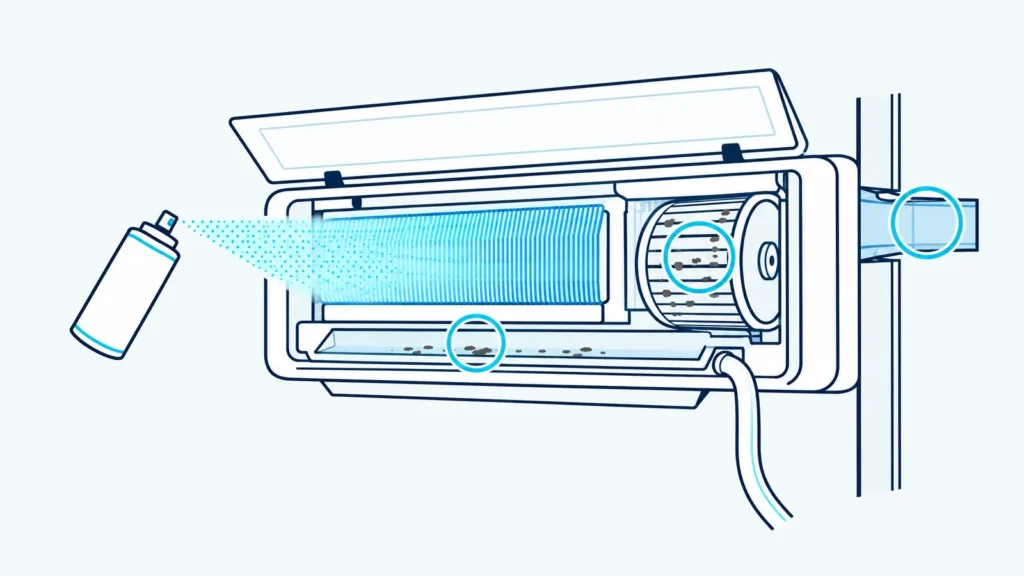
An ac coil cleaner reaches the parts you can see once the front panel is open. The indoor coil is fragile and hard to reach, and the drain tray, the blower and the ducts stay out of reach of a spray.
- Drain tray and its lines
- Blower (fan)
- Air ducts
Trane is clear on this point. AC coils are fragile parts that can bend or break with very little force, and they can be hard to access, especially the evaporator coil inside your home. For that reason, Trane says the majority of coil cleaning and maintenance should be left to a licensed HVAC professional.
The LG guide for the UAE (LG UAE, Arabic page) adds two useful facts:
- the self-clean function of the AC helps dry the moisture inside the indoor unit, but it does not go between the fins, so manual cleaning is still needed;
- the drain tray and the drain lines are left out of the LG owner's guide and given to a specialised technician.
The ENERGY STAR maintenance checklist draws the same line. In its list of actions to do yourself, it names the air filter: inspect it, clean it or change it. Cleaning the coils, checking the condensate drain and cleaning the blower components sit in the check-up done by a contractor.
So, in practice:
- Within reach: the air filter, and part of the face of the indoor coil once the panel is open.
- Out of reach of a spray: the drain tray and its lines, the blower (fan), the air ducts.
AC cleaner vs professional cleaning: what each one covers
An AC cleaner covers, at most, the face of the coil you can reach, and you can clean the filter yourself. A professional clean covers the parts behind them: between the fins, the drain tray, the blower and the ducts.
The table below puts each part of your AC side by side: what you can do yourself, according to the sources, and what the two BestNear offers cover, as written in each offer.
| Part of your AC | What you can do yourself | What a professional clean covers (BestNear) | Source |
|---|---|---|---|
| Air filter | Inspect, clean or change it | Filter cleaning in AC Deep Cleaning; air filter and grille cleaning in Air Duct Cleaning | ENERGY STAR |
| Face of the indoor coil | Partly, once the panel is open, following the label; coils are fragile | Cooling coil deep cleaning (AC Deep Cleaning) | Trane |
| Between the coil fins | Not reached by the self-clean function | Cooling coil deep cleaning (AC Deep Cleaning) | LG UAE |
| Drain tray and drain lines | Left out of the owner's guide, given to a technician | Drain tray cleaning and sanitisation (AC Deep Cleaning) | LG UAE, ENERGY STAR |
| Blower (fan) | Not on the list of actions to do yourself | Blower (fan) deep cleaning (AC Deep Cleaning) | ENERGY STAR |
| Air ducts | No | Air duct cleaning (AC Deep Cleaning); camera inspection, deep air duct cleaning and HEPA negative-air extraction (Air Duct Cleaning) | US EPA |
| Grilles and diffusers | Vacuum the return grilles | Grilles and diffusers cleaning (AC Deep Cleaning); air filter and grille cleaning (Air Duct Cleaning) | US EPA |
Sources: ENERGY STAR maintenance checklist, Trane, AC coil maintenance, LG UAE, filter and coil cleaning guide (Arabic), US EPA, Should You Have the Air Ducts in Your Home Cleaned?
Two limits to keep in mind. AC Deep Cleaning does not include the outdoor condenser, and it does not include a thermostat or electrical check. Air Duct Cleaning cleans the ducts and the filter only, not the AC unit itself.
For the ducts, the EPA describes how the work is usually done: the service provider uses specialised tools to loosen dirt and debris in the ducts, then vacuums them out with a high-powered vacuum. The EPA also asks that carpets and furniture be protected during the work, and that HEPA vacuum equipment be used if the vacuum exhausts inside the home. None of this can be done with a can.
Is an air conditioner cleaner safe to use yourself?
If you use an air conditioner cleaner, keep to the parts you can reach, cut the power first and follow the label. Trane says coil maintenance is dangerous and should be handled by a licensed technician.
Three rules come straight from the sources:
- Cut the power first. LG advises turning the power off at the circuit breaker or the wall switch before opening any part. While the unit still has power, it can start suddenly, and opening the panels carries a real risk of injury.
- Follow the manufacturer's guide and the product label. Your AC's guide says what you can open. The label says how to use the product.
- Leave coil work to a technician. Trane says AC coil maintenance is dangerous and should only be handled by a licensed HVAC technician. The coils bend or break with very little force.
Watch out with chemicals in the ducts. The US EPA explains that chemical biocides and other treatments inside air ducts have yet to be fully researched. It advises you to be fully informed before you allow them, and says they should only be applied, if at all, after the system has been properly cleaned of all visible dust or debris.
In short: a spray is a tool for the surface you can reach, with the power off. It is not a way into the unit or the ducts.
When should you consider a professional AC clean?
A professional clean makes sense when you see the signs the US EPA lists: substantial visible mold, ducts clogged with dust and debris, or particles coming out of the supply vents. Treat them as signs to have your system looked at.
The EPA says you should consider having your air ducts cleaned if:
- there is substantial visible mold growth inside hard surface ducts or on other parts of the heating and cooling system;
- the ducts are clogged with excessive amounts of dust and debris;
- particles are actually released into the home from the supply registers (the vents that blow air into the room).
The EPA also gives a reassuring point: it is normal for the return registers to get dusty, as air is pulled through the grate. That alone does not mean your ducts are heavily contaminated, and those grilles can be vacuumed.
Another point from the same EPA page is useful: when your system is maintained or checked, ask the service provider to clean the cooling coils and the drain pans too. These are exactly the parts a spray does not reach.
Finally, remember what you cannot check yourself. The drain tray, the blower and the inside of the ducts are hidden. If you are unsure, describe what you see or send a photo to the team on WhatsApp.
What does a professional clean cover that a spray can't?
A professional clean covers the hidden parts, with the work area protected and a service report at the end. BestNear offers two services: AC Deep Cleaning for the whole indoor system, and Air Duct Cleaning for the ducts and the filter.
AC Deep Cleaning: the whole indoor system
AC Deep Cleaning cleans your whole indoor AC system, ducts included. It is priced per AC unit: a central unit and a split unit cost the same. It includes:
- Protection of the working area
- Filter cleaning
- Air duct cleaning
- Grilles and diffusers cleaning
- Cooling coil deep cleaning
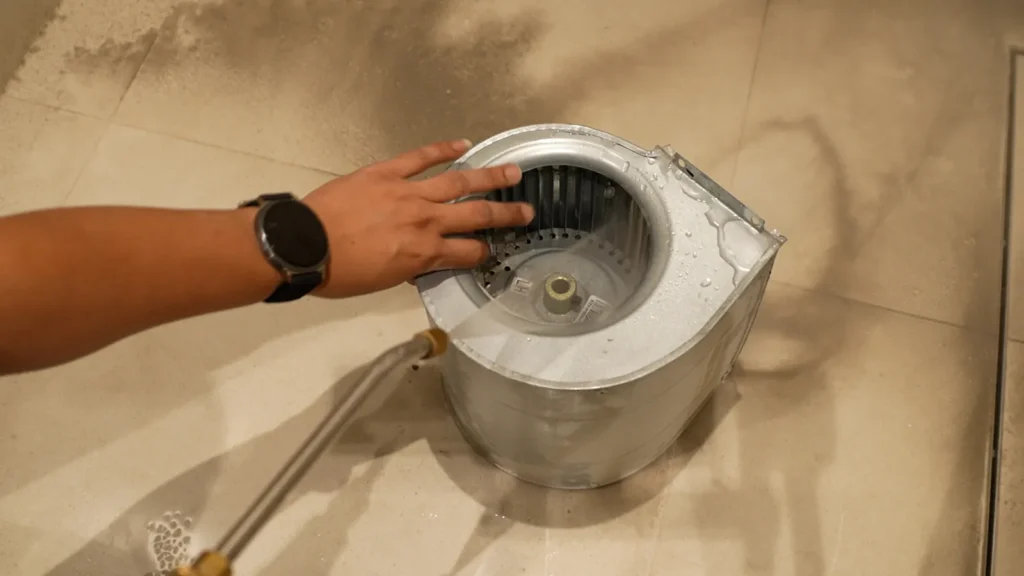
- Blower (fan) deep cleaning
- Drain tray cleaning and sanitisation
- Indoor component sanitisation
- Before / after photos and service report
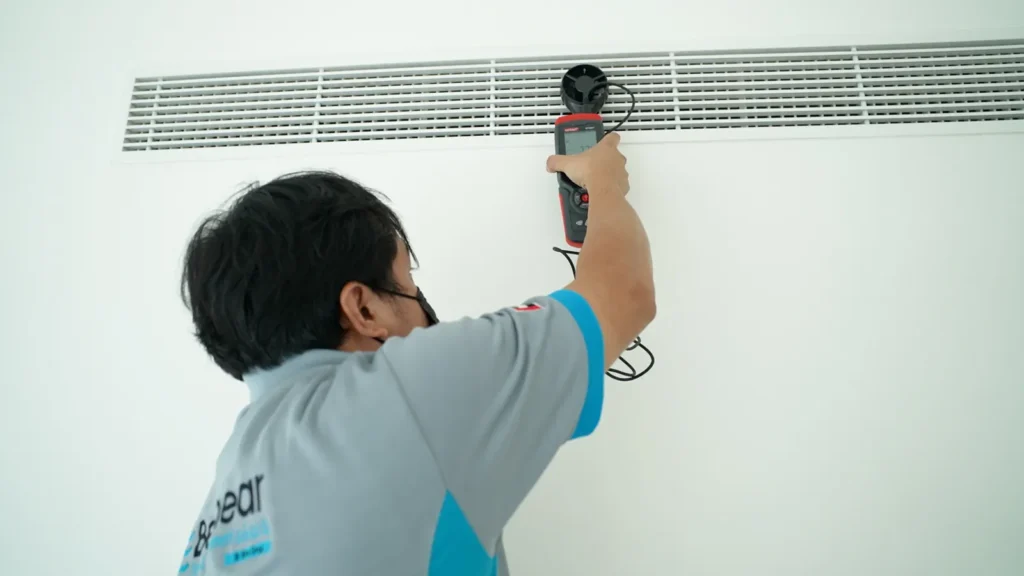
- Before / after measurements: temperature check, air velocity measurement, air quality check
AC Deep Cleaning does not include the outdoor condenser, and it does not include a thermostat or electrical check. If you have a question about these, ask the team.
Air Duct Cleaning: the ducts and the filter only
Air Duct Cleaning cleans your ducts and your filter only. It is priced per home: apartment or villa, and the number of bedrooms. It includes:
- Camera inspection of the ducts
- Deep air duct cleaning
- Duct sanitisation and disinfection
- Air filter and grille cleaning
- HEPA negative-air extraction
- Protection of the work area
- BestNear service report
- Before / after measurements: temperature check
This offer does not clean the AC unit itself: the cooling coil, the blower and the drain tray are part of AC Deep Cleaning. You can read more on the Air Duct Cleaning page.
Which one fits your home?
It depends on your home and on what you see. The team helps you pick based on your home. You can also book both offers in one visit: the two prices are added together.
The before and after measurements show the state of your system at the time of the visit. They are not a promise of a result.
The BestNear team works in homes in Dubai and Sharjah, with no travel fee for Sharjah. See AC cleaning in Sharjah for details.
AC cleaner FAQ
Can an AC cleaner spray replace a professional AC clean?
No. An AC cleaner works only where you apply it, on the parts you can reach. The drain tray, the blower and the ducts stay out of reach, and Trane advises leaving most coil cleaning to a technician.
Is an ac coil cleaner safe to use on my indoor unit?
Cut the power at the breaker or the wall switch before you open any part, and follow the instructions on the label. Coils are fragile and hard to reach, and Trane says coil maintenance should be handled by a licensed technician.
What does an air conditioner cleaner not reach?
It does not reach the drain tray and its lines, the blower or the air ducts. These parts are hidden inside the unit or the walls.
How do I know my AC needs a professional clean?
The US EPA lists signs such as substantial visible mold, ducts clogged with dust and debris, or particles coming out of the supply vents. A little dust on the return grilles is normal.
What is the difference between AC Deep Cleaning and Air Duct Cleaning?
AC Deep Cleaning cleans the whole indoor system, ducts included, and is priced per AC unit. Air Duct Cleaning cleans the ducts and the filter only, with a camera inspection and HEPA extraction, and is priced per home.
AC cleaner or a pro: the short answer
An AC cleaner is a tool for the surface you can reach, with the power off and the label in hand. The drain tray, the blower and the ducts are another job, and the sources above leave them to a technician or a service provider. If you see mold, heavy dust or particles coming out of the vents, have your system looked at. Send your number of AC units on WhatsApp and the team prepares your price, call +971 52 332 0944, or contact the team.