
If you are reading about duct cleaning, you have probably seen a grey line of dust on a ceiling grille and wondered what is inside your ac duct. It is a fair question: the ducts are hidden above the ceiling, and every offer seems to promise something different.
Here is the short answer. Duct cleaning is the cleaning of the ducts that carry cooled air from a central AC to each room, and back to the unit. It removes dust and debris, and in some cases mold, from inside the ducts and the grilles. The US EPA does not recommend it as a routine: it says to consider it when there is substantial visible mold, insects or rodents, or ducts clogged with dust.
In this guide: what duct cleaning is, what builds up in an AC duct, which signs matter, how air duct cleaning works and what to ask before you book. Every technical point links to its source: the US EPA, NADCA (the US association of air duct cleaners) and Dubai Municipality.
What is duct cleaning?
Duct cleaning is the cleaning of the supply and return ducts of a central AC system, with their grilles and diffusers. According to the US EPA, the term generally covers more than the ducts: the coils, the drain pans and the fan can be part of it too.
A central AC moves air in a loop: supply ducts carry the cooled air to each room through the supply grilles or diffusers, and return ducts bring the room air back to the unit through the return grilles.
The US EPA explains that the term generally covers several parts of the system: the supply and return ducts, the grilles and diffusers, the coils, the condensate drain pans, the fan and the air handling unit housing. You may also see the job called ac duct cleaning or air duct cleaning.
Central AC or split: do you have ducts?
Duct cleaning applies to a central AC, where the cooled air travels through ducts. A wall-mounted split unit blows air straight into the room, so there is no duct behind it to clean.
In the homes the BestNear team visits, the AC is almost always central: ducts above the ceiling, grilles in the ceiling and one thermostat per zone. A single unit high on the wall, with its own remote, usually means a split.
Good to know: NADCA writes that "air duct cleaning is a misnomer": in its view, the entire HVAC system should be cleaned, because a part left dirty can recontaminate the rest.
What builds up inside an AC duct?
An AC duct collects dust, particles and debris carried by the air. Where moisture is present, mold can grow, and in some homes insects or rodents get in. Dubai Municipality links dirt in ventilation systems, combined with poor water management, to biological growth.
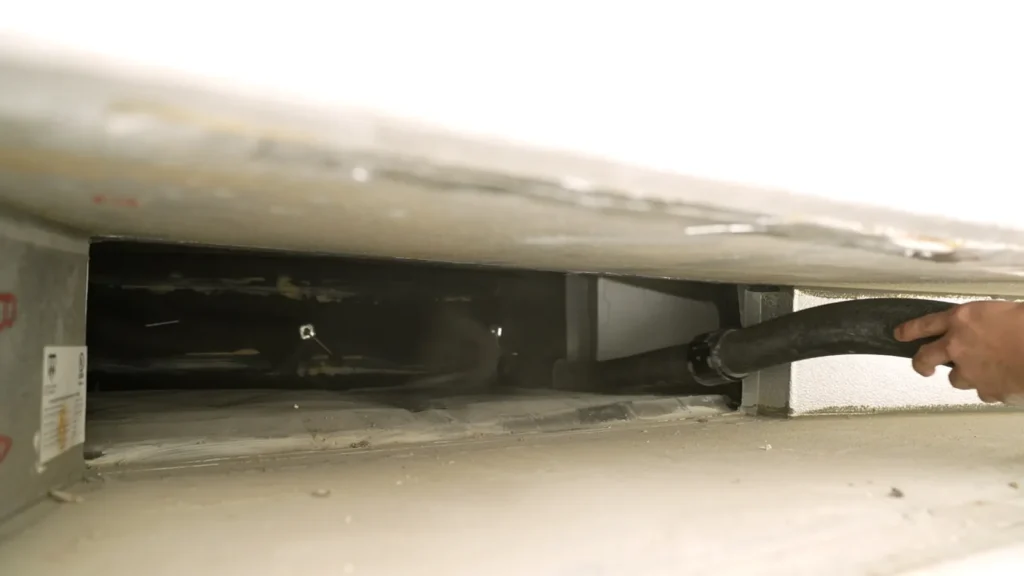
- Dust, pollen and debris. The EPA explains that parts of a system that is not properly installed, maintained and operated may become contaminated with dust, pollen or other debris. The indoor air quality guidelines of Dubai Municipality (DM-HSD-GU119-IAQ) list construction and renovation, vacuuming and insulation among the sources of particles and fibres.
- Moisture. According to the EPA, if moisture is present, the potential for mold growth is increased. Dubai Municipality writes that "dirt accumulation in ventilation systems, combined with poor management of water, can lead to biological growth in the airstream", for example through poor filter maintenance or problems with cooling coil condensate.
- Mold and microbial growth. In its list of indoor contaminant sources, Dubai Municipality names the HVAC system itself, with "microbiological growth in drip pans, humidifiers, ductwork, coils".
- Insects and rodents. The EPA lists ducts "infested with vermin", such as rodents or insects, among the cases where cleaning should be considered.
Dubai Municipality also describes the climate of Dubai as hot and humid in summer.
One reassuring fact from the EPA: much of the dirt in air ducts sticks to the duct surfaces and does not necessarily enter the living space.
Which signs make duct cleaning worth considering?
According to the US EPA, three signs justify considering duct cleaning: substantial visible mold, ducts infested with insects or rodents, and ducts clogged with dust, or particles actually coming out of the supply grilles. A dusty return grille, on its own, is normal.
| Sign | What it means | What to do | Source |
|---|---|---|---|
| Dust on the return grille (the one that pulls air in) | Normal: air full of room dust is pulled through it | Vacuum the grille, or remove it and clean it. This alone does not call for duct cleaning | US EPA |
| Dust or particles blowing out of the supply grilles | The ducts may be clogged with dust and debris | Have the inside of the ducts inspected, then cleaned if this is confirmed | US EPA |
| Visible mold on the grilles or inside the ducts | Moisture in the system, for example from condensate | Have it inspected, and have the cause of the moisture dealt with, or the mold will come back | US EPA; Dubai Municipality |
| Musty smell when the AC starts | Possible mold somewhere in the system | Have the system inspected; see why your AC smells | US EPA |
| Insects, droppings or rodents | Pests in the ducts | Have the pests dealt with first, then have the ducts cleaned | US EPA |
| Recent renovation work at home | Building dust may have entered the system | During dusty work, seal the supply and return grilles and do not run the AC until the dust is cleaned up; if dust got in anyway, have the ducts checked | US EPA; Dubai Municipality |
| Wet or moldy duct insulation | Wet or moldy insulation cannot be cleaned effectively | It should be removed and replaced: this is replacement work, not cleaning | US EPA |
Sources: US EPA, Should You Have the Air Ducts in Your Home Cleaned?, Dubai Municipality, Technical Guidelines for Indoor Air Quality (DM-HSD-GU119-IAQ, v3, 2024).
The EPA adds that each of these signs usually points to an underlying cause, which must be corrected before any cleaning, or the problem will likely come back. And something that looks like mold can only be confirmed by an expert, sometimes with a laboratory test.
When is duct cleaning not needed?
If nobody at home has allergies or unexplained symptoms, and a look inside the ducts shows no large deposits of dust or mold, no musty odour and no visible mold, the US EPA says having your air ducts cleaned is probably unnecessary.
Here is what the EPA says, plainly:
- Knowledge about air duct cleaning is in its early stages, so a blanket recommendation cannot be offered.
- Duct cleaning has never been shown to actually prevent health problems.
- There is no evidence that a light amount of household dust in air ducts poses any risk to health.
- Little evidence exists that cleaning only the ducts will improve the efficiency of the system.
- Done properly, no evidence suggests it is harmful. Done badly, for example with poor vacuum collection, it can release more dust than if the ducts had been left alone.
If someone at home has unexplained symptoms you think are linked to your home, the EPA's advice is to talk to your doctor.
What you can do yourself
According to the EPA, keeping water and dirt out of the system is the most effective way to prevent contamination. A few habits from the sources:
- Use the highest efficiency air filter recommended by the maker of your AC, change it regularly, and more often if it gets clogged. Follow your AC's manual.
- Vacuum the return grilles when they get dusty.
- During dusty renovation work, seal the supply and return grilles and keep the AC off until the dust is cleaned up.
- Keep indoor relative humidity below 60 %, as Dubai Municipality's guidelines advise to control mold.
Leave anything that needs tools or opening the system to a professional.
How does air duct cleaning work?
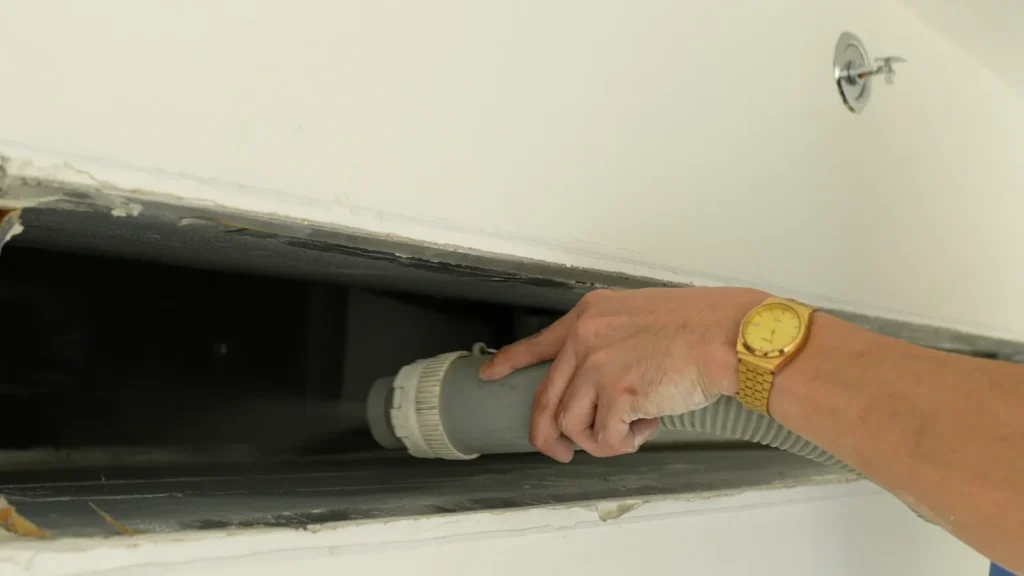
Professional air duct cleaning works in two steps, as NADCA describes them. First, the dirt stuck inside the ducts is loosened with brushes or air tools. Then it is collected with the system under continuous negative pressure, so the loosened dirt is extracted and removed from your home instead of spreading.
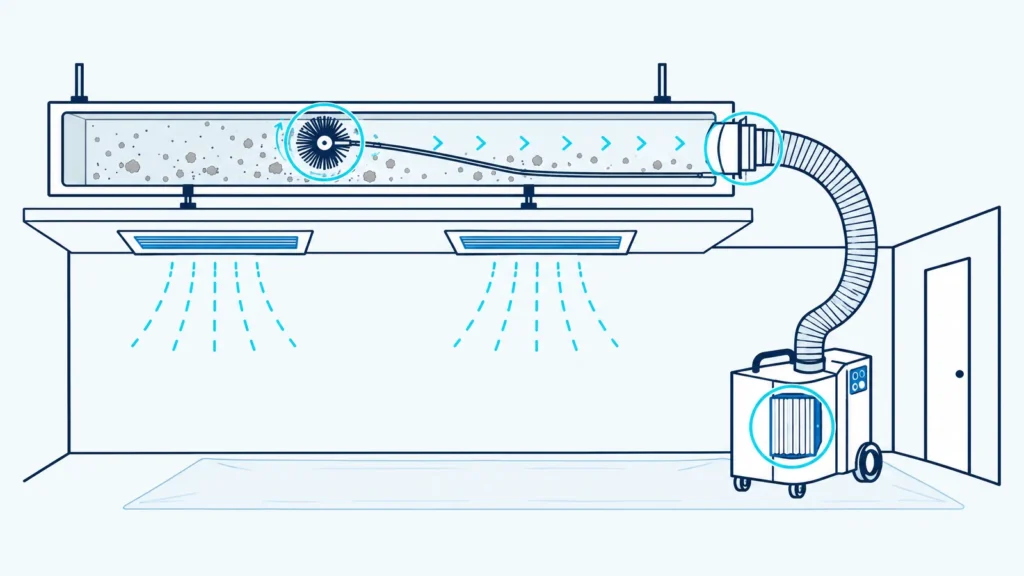
- Brushes
- Negative pressure
- HEPA
According to NADCA, the tools include brushes, air whips and compressed air nozzles. Where possible, the ducts are reached through existing openings such as supply diffusers and return grilles.
The EPA lists what you should expect from a service provider. They should:
- open access points so the entire system can be cleaned and inspected;
- use vacuum equipment that sends particles outside, or HEPA vacuum equipment if the vacuum exhausts inside the home;
- protect carpets and household furniture during the work;
- seal any access holes they made or used, so they are airtight.
The EPA adds that some service providers use remote photography to document conditions inside the ducts, and it calls a thorough visual inspection the best way to check the result.
What BestNear's Air Duct Cleaning includes
Air Duct Cleaning is BestNear's offer for the ducts. It cleans the ducts and the filter only, with a camera inspection and HEPA extraction, and it is priced per home: apartment or villa, and the number of bedrooms. It includes:
- Camera inspection of the ducts
- Deep air duct cleaning
- Duct sanitisation and disinfection
- Air filter and grille cleaning
- HEPA negative-air extraction
- Protection of the work area
- BestNear service report
- Before / after measurements: temperature check
On this list, the camera inspection and the HEPA negative-air extraction relate to two points described above: seeing inside the ducts, and collecting the dust with HEPA-filtered negative air. The before and after temperature check shows the state of your system at the time of the visit. It is not a promise of a result.
Air Duct Cleaning does not clean the AC unit itself: the cooling coil, the blower and the drain tray are part of AC Deep Cleaning. You can read more on the Air Duct Cleaning page.
About disinfection
The EPA says chemical biocides and treatments in air ducts have yet to be fully researched, that you should be fully informed before you allow them, and that they should only be applied, if at all, after the system has been cleaned of all visible dust or debris. NADCA says antimicrobial products should only be considered after mechanical cleaning, if the need has been deemed necessary. Before the visit, you can ask the team which product is used and why.
Duct cleaning or a full indoor AC clean: what does each cover?
BestNear has two offers. AC Deep Cleaning cleans the whole indoor AC system, ducts included, and is priced per AC unit. Air Duct Cleaning cleans the ducts and the filter only, with a camera inspection and HEPA extraction, and is priced per home.
The content of each offer, as written in each offer:
| What is covered | AC Deep Cleaning | Air Duct Cleaning |
|---|---|---|
| Air ducts | Air duct cleaning | Deep air duct cleaning |
| Camera inspection of the ducts | — | Yes |
| HEPA negative-air extraction | — | Yes |
| Duct sanitisation and disinfection | — | Yes |
| Filter | Filter cleaning | Air filter and grille cleaning |
| Grilles and diffusers | Grilles and diffusers cleaning | Air filter and grille cleaning |
| Cooling coil | Cooling coil deep cleaning | — |
| Blower (fan) | Blower (fan) deep cleaning | — |
| Drain tray | Drain tray cleaning and sanitisation | — |
| Other indoor parts | Indoor component sanitisation | — |
| Protection of the work area | Yes | Yes |
| Report | Before / after photos and service report | BestNear service report |
| Before / after measurements | Temperature check, air velocity measurement, air quality check | Temperature check |
| Price based on | Number of AC units (central or split, same price per unit) | Apartment or villa, and number of bedrooms |
— : not on this offer's list. AC Deep Cleaning does not include the outdoor condenser, and it does not include a thermostat or electrical check.
Remember the NADCA point: the ducts are one part of a system that also includes the coil, the drain pan and the fan. Which offer fits depends on your home and on what you see: the team helps you choose. You can also book both offers in one visit: the two prices are added together. If you were thinking of a spray instead, see what a spray cleaner can't reach.
The BestNear team works in homes in Dubai and Sharjah, with no travel fee for Sharjah. See AC cleaning in Sharjah for details.
What should you ask before booking duct cleaning?
Ask to see the contamination, get the scope and the price in writing before the work starts, ask which product is applied and why, and check how your home is protected and how the dust is collected. After the work, ask to see the cleaned parts.
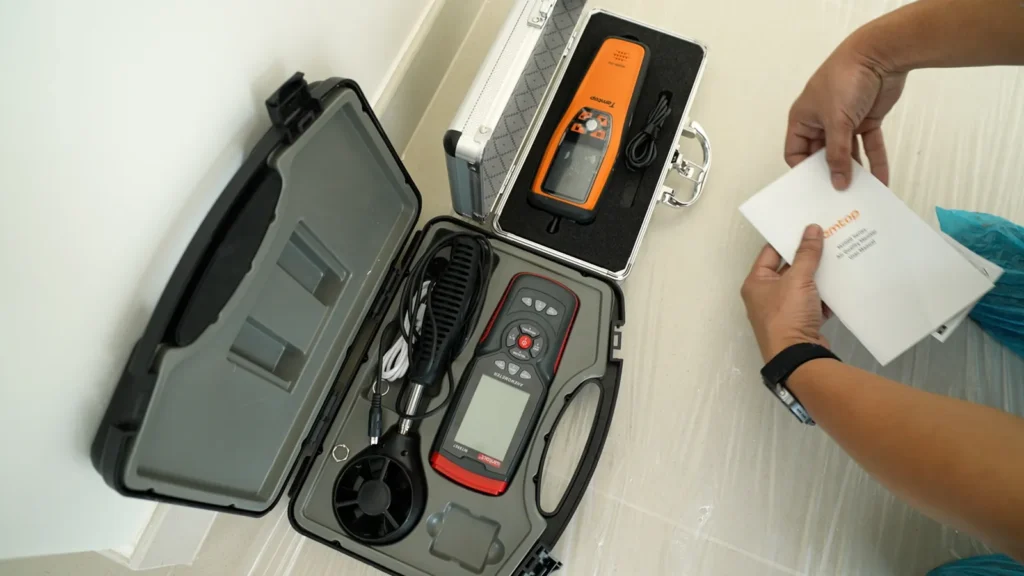
These questions come from the EPA's advice on choosing a provider:
- Can you show me the contamination? Ask to see what would justify the cleaning, including any mold they say exists.
- What exactly is included, and at what price? Get a written agreement with the total cost and scope of the job before work begins. The EPA also suggests talking to at least three providers and getting written estimates.
- Which product will you apply, and why? Do not allow chemical biocides or treatments unless you fully understand the pros and the cons.
- How will you protect my home and collect the dust? Look for protection of carpets and furniture, and HEPA equipment if the vacuum exhausts inside the home.
- Can you show me the result? After the job, ask to see each part that was cleaned.
The EPA also warns against providers who make sweeping health claims, which it calls unsubstantiated, or who recommend duct cleaning as a routine part of maintenance.
With BestNear, the price is confirmed before booking, and what is included is agreed before booking. Air Duct Cleaning comes with a BestNear service report and a before and after temperature check.
Duct cleaning: frequently asked questions
Is duct cleaning worth it?
It depends on what is in your ducts. The US EPA says to consider it if there is substantial visible mold, if insects or rodents are in the ducts, or if the ducts are clogged with dust or particles come out of the supply grilles. It does not recommend it as a routine.
Does duct cleaning improve your health?
No one can promise that. According to the US EPA, duct cleaning has never been shown to actually prevent health problems, and there is no evidence that a light amount of household dust in air ducts poses any risk to health.
Do split AC units have ducts?
A wall-mounted split unit has no ducts: it blows air straight into the room. Duct cleaning concerns central AC systems, with ducts and grilles in the ceiling, which is the setup in most homes the BestNear team visits.
Is a dusty AC grille a sign my ducts are dirty?
Not on its own. The EPA says it is normal for return grilles to get dusty, and they can be vacuumed or removed and cleaned. Dust or particles blowing out of the supply grilles is a sign to have the ducts checked.
Do you offer duct cleaning in Dubai and Sharjah?
Yes. BestNear's Air Duct Cleaning is available in Dubai and Sharjah, with no travel fee for Sharjah. The price depends on your home, apartment or villa, and the number of bedrooms, and it is confirmed on WhatsApp before booking.
Duct cleaning: the short answer
Duct cleaning is worth considering when there is something real to remove: substantial mold, pests, or dust actually coming out of the supply grilles. A dusty return grille is normal, and the EPA is clear that the work has never been shown to prevent health problems. If you see one of these signs, have your ducts checked. For duct cleaning in Dubai or Sharjah, send your home type and number of bedrooms on WhatsApp and the team prepares your price, call +971 52 332 0944, or contact the team.