


An AC smell is hard to ignore: you switch on the cooling, and the air smells damp, stale or sour instead of fresh. If your AC smells bad every time it starts, you are right to ask what is going on inside the unit.
Here is the short answer. The most common cause of a musty smell from AC units is moisture: water collects on the cooling coil and in the drain tray, and mold or bacteria grow there and on the dust that builds up. Burning, rotten-egg, gas or chemical smells are different: they are a safety warning, not a cleaning job.
In this guide: the six common causes of a bad smell from AC systems, a smell-by-smell table, the smells that mean you should switch off, what you can check yourself, and which cleaning covers which part. Each technical point names its source, including Dubai Municipality and the US EPA.
What causes an AC smell?
An AC smell usually comes from moisture and dirt inside the system. The air passes over the cold, wet cooling coil, near the drain tray and through the ducts, and carries any odor growing there into the room.
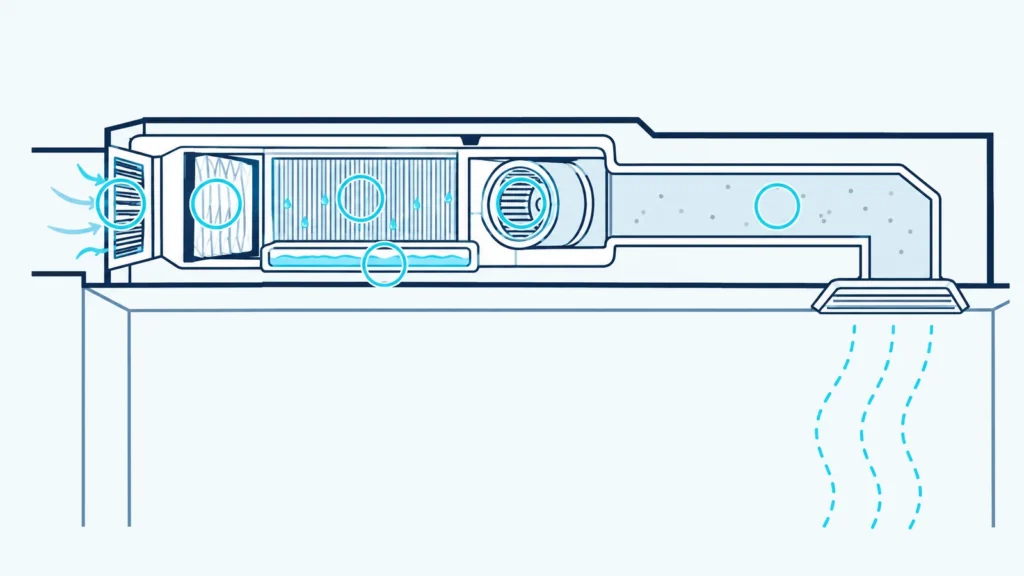
- Grilles
- Filter
- Cooling coil
- Drain tray
- Blower (fan)
- Ducts
An AC smell is any odor carried into your room by the air your system blows: from the filter, the cooling coil, the drain tray, the blower (fan) or, in a central system, the ducts and grilles. Water on the coil is normal, since the coil pulls water out of the air as it cools it. The US EPA explains that cooling coils can be a major source of moisture in the system that can lead to mold growth. The problem starts when water or dust stays in place.
Dubai Municipality's Technical Guidelines for Indoor Air Quality for Healthy Life (DM-HSD-GU119-IAQ) also lists microbiological growth in drip pans, ductwork and coils among HVAC sources of indoor air problems.
Many homes in Dubai and Sharjah have central AC, with ducts in the ceiling and one thermostat per zone. A smell that starts in the indoor unit can then travel through the ducts to every room the unit serves.
Bad smell from AC: 6 common causes
Six causes explain most bad smells from AC systems: mold on the cooling coil, bacteria on a dirty coil, standing water in the drain tray, a dirty filter, dust or mold in the ducts, and an odor that comes from somewhere else.
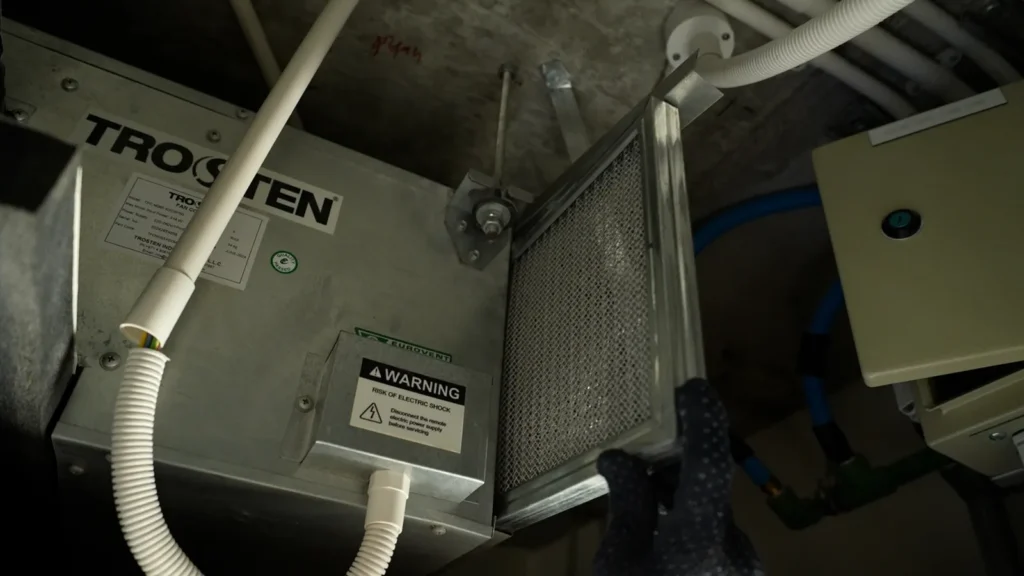
1. AC smells musty: mold on the cooling coil
A musty, damp smell is the most common one. The US EPA explains that molds release compounds called mVOCs, which can be the source of the musty smell linked to mold, and that a moldy odor suggests mold is growing and should be investigated. Inside an AC, Daikin Middle East & Africa (Arabic page) points to the evaporator coil and the drain tray.
2. Bacteria on a dirty coil
Some people compare the smell to old gym socks. Daikin explains that it comes from bacteria growing on dirty evaporator coils and feeding on the dust on their surface. It is not dangerous in most cases, Daikin says, but it shows the coil needs a professional clean, not just a new filter. Carrier describes a similar sour or stale smell.
3. Standing water in the drain tray
Your AC collects the water it removes from the air in a drain tray (or drip pan). The EPA says substantial standing water there is a problem requiring immediate attention, and Carrier notes that stagnant water can develop a swamp-like odor. A blocked drain line or a leak is not a cleaning job: have a qualified AC technician check it.
4. A dirty air filter
Carrier explains that when filters are not changed, the dust they trap can start to give off odors. Daikin adds that a dry, dusty smell is often dust that built up while the AC was off, and that it usually fades once the filter is cleaned or replaced.
5. Dust and mold in the ducts and grilles
In a central system, the air also travels through ducts, which can collect dust and debris. The EPA suggests you consider duct cleaning when there is substantial visible mold, when the ducts are clogged with excessive dust and debris, or when particles come out of the supply vents. Some dust on the return grilles is normal.
6. A smell that does not come from your AC
Sometimes the AC only spreads a smell from elsewhere. For split units, Trane gives a simple test: if you can smell it when the unit is off, it is not the unit.
What does each AC smell mean?
Musty, damp or sour smells usually point to moisture and dirt inside the unit or the ducts. Burning, rotten-egg, gas or chemical smells point to a safety problem: switch off and get the right help.
| Smell | Likely cause | What to do | Source |
|---|---|---|---|
| Musty, damp, moldy | Mold on the cooling coil, in the drain tray or in the ducts | Check the filter. If the smell comes back, have the coil, the drain tray and the ducts cleaned | US EPA, Dubai Municipality, Daikin |
| Old socks, sour, stale | Bacteria on a dirty evaporator coil or in the drain pan | Have the coil cleaned: a new filter alone is not enough | Daikin, Carrier |
| Swampy, stale water, sewage | Standing water in the drain tray, blocked drain line | Look for visible water. Blocked drain or leak: a qualified AC technician | US EPA, Carrier, Daikin |
| Dry and dusty | Dirty filter, dust in the unit or the ducts | Clean or change the filter as your manual says; consider duct cleaning if the ducts are clogged with dust | Daikin, US EPA |
| Burning, electrical | Overheating parts or wiring | Switch off at the breaker and contact a qualified technician | Daikin, Carrier |
| Rotten eggs, sulfur, gas | Possible gas leak near the system | Switch off, open the windows, leave the home and contact a professional | Carrier |
| Sweet, chemical, vinegar | Possible refrigerant leak or overheating part | Switch off and contact a qualified technician | Daikin, Trane |
Which air conditioner smell is a safety warning?
A burning, electrical, rotten-egg, gas or chemical air conditioner smell is a safety warning, not a cleaning job. Switch the AC off and get qualified help before you use it again.
- Burning or electrical. Daikin links this smell to overheating parts, a worn motor or damaged wiring; Carrier calls it a fire hazard. Switch off at the breaker and contact a qualified technician.
- Rotten eggs or sulfur. Carrier calls this a critical warning sign that often means a natural gas leak near the system, and advises you to turn the unit off, open the windows, leave the home and contact a professional.
- Sweet or chemical. Daikin says it can mean a refrigerant leak; Trane says a vinegar-like smell can mean parts are overheating. Switch off and contact a qualified technician.
A cleaning does not deal with any of these.
AC smells bad: what can you check yourself?
If your AC smells bad but not of burning, gas or chemicals, start with the filter and the humidity in your home. If the smell comes back, the cause is probably in parts that a filter change does not reach.
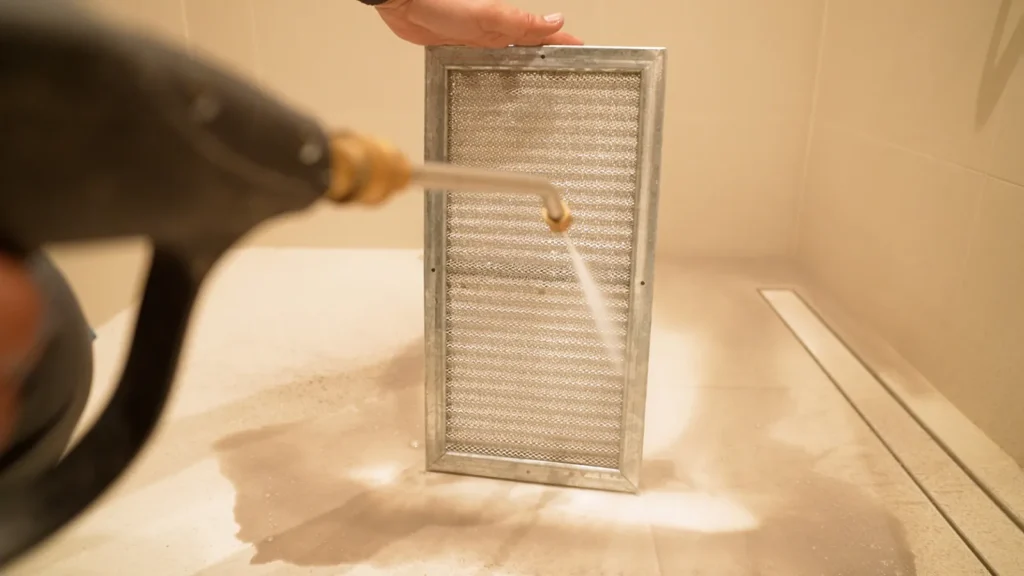
What you can do yourself
- Clean or change the filter as your AC's manual says. The ENERGY STAR maintenance checklist lists this among the actions to do yourself.
- Keep indoor humidity below 60%. Dubai Municipality's guide says: "Keep relative humidity below 60%". The US EPA gives the same limit, ideally 30% to 50%, and asks you to keep AC drip pans clean and drain lines flowing properly.
- Look, don't dismantle. Open only what your manual allows, and leave anything electrical alone.
You may also see AC cleaner sprays in shops. Our guide AC cleaner or a pro explains what a can reaches inside your AC and what it doesn't.
When a musty smell from AC keeps coming back
- The smell returns once the filter is clean. Daikin says the problem is then deeper than dust or the filter.
- You see mold on a grille, the unit or a duct. Carrier advises against cleaning mold on or inside the unit yourself. The EPA says not to run a system you know or suspect is contaminated with mold, because it could spread mold through the building.
- The smell is in every room. On a central system, the ducts are probably involved, not just one unit.
The EPA also notes that if the conditions that caused the mold are not corrected, it will come back.
AC smells like mold: which cleaning covers which part?
If your AC smells like mold, the cleaning has to reach the parts where the smell starts. At BestNear, AC Deep Cleaning cleans the whole indoor system, ducts included. Air Duct Cleaning cleans the ducts and the filter only.
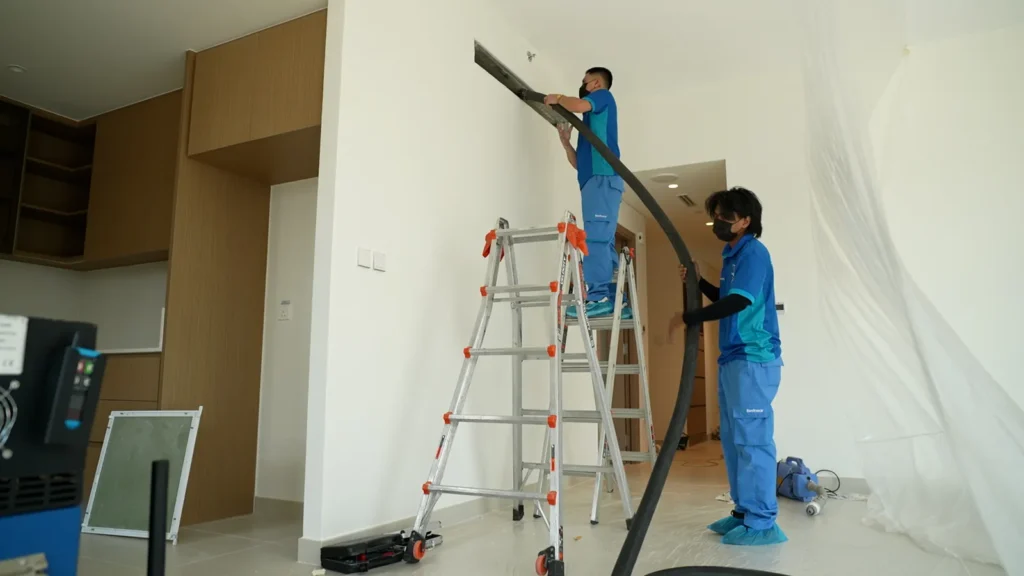
AC Deep Cleaning: the whole indoor system
AC Deep Cleaning cleans your whole indoor AC system, ducts included. It is priced per AC unit: a central unit and a split unit cost the same. It includes:
- Protection of the working area
- Filter cleaning
- Air duct cleaning
- Grilles and diffusers cleaning
- Cooling coil deep cleaning
- Blower (fan) deep cleaning
- Drain tray cleaning and sanitisation
- Indoor component sanitisation
- Before / after photos and service report
- Before / after measurements: temperature check, air velocity measurement, air quality check
It does not include the outdoor condenser, or a thermostat or electrical check.
Air Duct Cleaning: the ducts and the filter only
Air Duct Cleaning cleans your ducts and your filter only. It is priced per home: apartment or villa, and the number of bedrooms. It includes:
- Camera inspection of the ducts
- Deep air duct cleaning
- Duct sanitisation and disinfection
- Air filter and grille cleaning
- HEPA negative-air extraction
- Protection of the work area
- BestNear service report
- Before / after measurements: temperature check
The cooling coil, the blower and the drain tray are part of AC Deep Cleaning. Read more on the Air Duct Cleaning page.
Which one fits your smell?
Use the table above to see where your smell probably starts, then tell the team what you notice: the team helps you choose based on your home. Both offers can be booked in one visit, the two prices added together, and the price is confirmed before booking. The before and after measurements show the state of your system at the time of the visit, not a promise of a result.
The BestNear team works in homes in Dubai and Sharjah, with no travel fee for Sharjah. See AC cleaning in Sharjah.
AC smell: frequently asked questions
Why is the AC smell stronger when I first turn it on?
Daikin Middle East & Africa explains that moisture, dust and organic matter build up inside the system while it is off, and the first push of air carries the smell into the room. If the smell comes back every time you switch on, its cause is still there.
Is a musty AC smell harmful?
The US EPA says a moldy odor suggests that mold is growing and should be investigated, and that the health effects of breathing the compounds behind this smell are largely unknown. Find the source instead of masking the smell.
Is cleaning the filter enough to stop the smell?
Sometimes, if the smell comes from dust on the filter. If it comes back once the filter is clean, the source is probably on the cooling coil, in the drain tray or in the ducts, which a filter change does not reach.
Should I keep using my AC if it smells like burning or gas?
No. Switch it off. For a burning or electrical smell, contact a qualified technician. For a rotten-egg or gas smell, open the windows, leave the home and contact your gas supplier or the emergency services.
Do you clean ACs with a bad smell in Dubai and Sharjah?
Yes. The BestNear team offers AC Deep Cleaning and Air Duct Cleaning in homes in Dubai and Sharjah, with no travel fee for Sharjah. Send your number of AC units, or your home type and number of bedrooms for Air Duct Cleaning, on WhatsApp and the team prepares your price.
AC smell: the short answer
An AC smell tells you where to look. Musty, damp or sour usually means moisture and dirt on the coil, in the drain tray or in the ducts; burning, gas or chemical means switch off and get qualified help. Start with the filter and the humidity in your home. Which smell do you notice? If it keeps coming back, send your number of AC units on WhatsApp, call +971 52 332 0944, or contact the team.